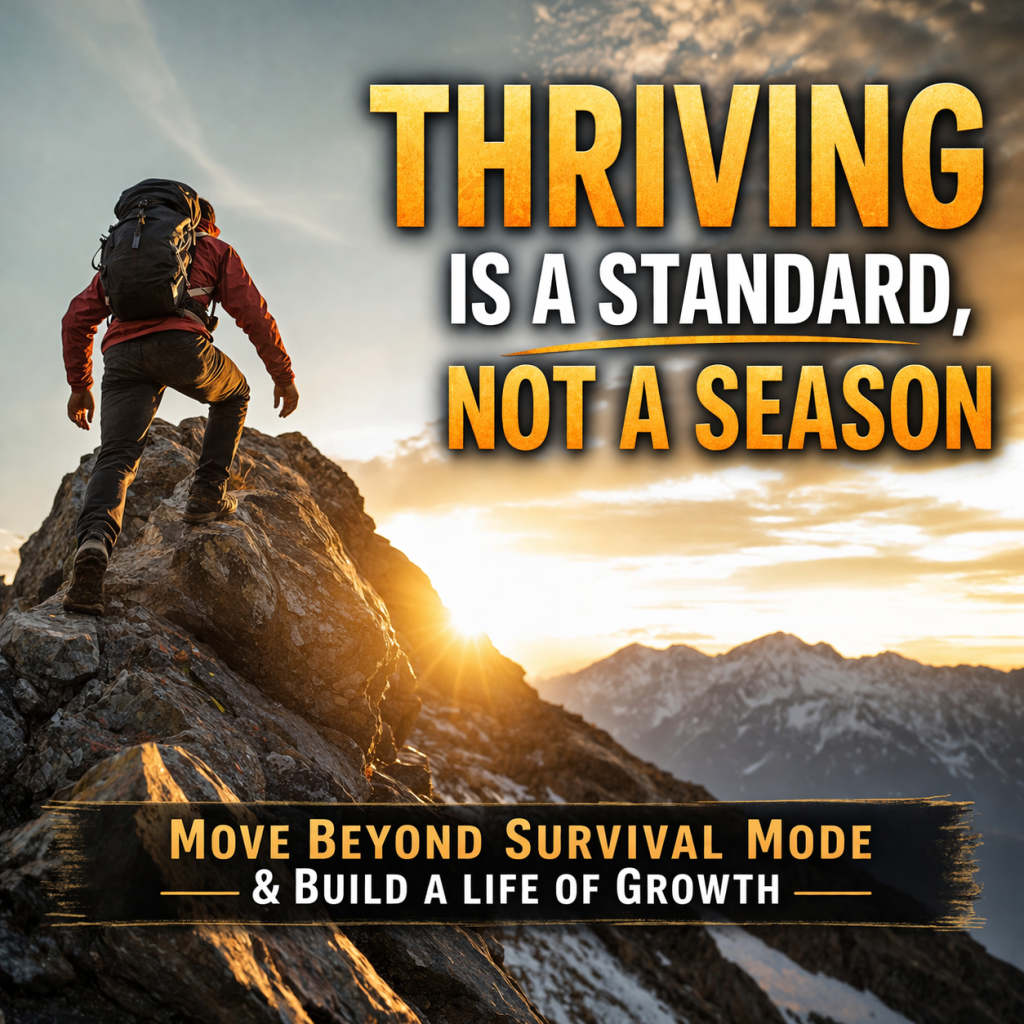
Theme: Thriving Is a Standard, Not a Season!
John 10:10 (KJV) “I am come that they might have life, and that they might have it more abundantly.”
Thriving Is a Standard, Not a Season
Some people think thriving means making it through the day. Others think it means surviving pressure, paying the bills, or keeping things together just enough to avoid falling apart. But thriving is deeper than that. It is not just endurance. It is not just maintenance. It is not just getting by.
Thriving means you are growing, developing, and moving forward with intention. It means your life is producing, not just existing. It means you are not trapped in reaction mode, but learning how to live, build, and operate from strength.
We have normalized stress, glorified struggle, and mistaken survival for success. But there are levels to life, and thriving sits in a different category. Thriving is not a lucky season. It is a standard.
What Does It Really Mean to Thrive?
To thrive means to grow, develop, and succeed at a high level while consistently producing results in a healthy and strong way. That definition matters because it pulls us out of vague language and forces us to deal with the real issue. Thriving is not just being active. Thriving is not just being busy. Thriving is not just having a moment where things work out.
Thriving is when your life has direction. It is when your actions are aligned with where you are trying to go. It is when your effort is producing progress instead of simply helping you survive another day. When a person is thriving, they are not just managing pressure. They are growing through it.
That is why thriving cannot be reduced to emotion. You may feel tired and still be thriving. You may be challenged and still be thriving. The real question is whether your life is developing, whether your thinking is expanding, and whether your daily habits are supporting your next level.
The Difference Between Surviving and Thriving
Surviving says, “I made it through.” Thriving says, “I moved forward.” Surviving is about preserving energy, minimizing damage, and trying not to collapse under pressure. Thriving is about building, producing, and strengthening your life with intention.
Survival mode can keep you alive, but it cannot build legacy. It trains you to react instead of prepare. It teaches you to focus only on what is urgent and ignore what is important. It narrows your vision and forces your energy into short-term thinking.
Thriving, on the other hand, moves with clarity. It creates room for growth, wise decisions, stronger habits, and healthier outcomes. A person who is thriving is not simply trying to avoid failure. They are building a life that can carry weight, pressure, responsibility, and purpose.
Most People Are Not Thriving
Research helps expose what many people are feeling but may not have language for. Gallup’s State of the Global Workplace found that only 23% of employees worldwide are thriving, while the majority are either disengaged or struggling. That means many people are showing up physically, but not mentally, emotionally, or strategically.
That matters because it reveals how common survival mode has become. A person can be present and still not be progressing. They can be busy and still not be building. They can be functioning on the outside while slowly draining on the inside.
When survival becomes normal, people begin to accept low-functioning patterns as if they are just part of life. But common does not mean healthy, and normal does not mean optimal. If thriving is rare, then it must be pursued on purpose.
Why Survival Mode Limits Growth
The American Psychological Association has highlighted how chronic stress affects long-term thinking and decision-making. That means survival mode does not just make life feel harder. It reduces your ability to think clearly about the future.
When stress stays high for too long, people stop building and start reacting. They make short-term choices, protect temporary comfort, and struggle to maintain the mental margin needed for strategy. This is one reason so many people feel stuck. It is not always because they lack opportunity. Sometimes they lack the internal capacity to process opportunity well because they have been overloaded for too long.
That is why thriving requires more than inspiration. It requires you to come out of mental chaos and into a place where your mind, habits, and structure can support wise movement. You cannot build a strong future if your entire life is organized around surviving the present.
Thriving Means Entering Game Mode
Thriving is game mode. It is the shift from random effort to intentional execution. It is when you stop waking up hoping things work out and start moving with focus, discipline, and direction.
In game mode, you protect your time. You make decisions based on purpose, not pressure. You stop giving your best energy to everything and start directing it toward what actually matters. You do not just respond to life. You run plays.
This is what separates people who are constantly overwhelmed from people who are building. Thriving does not mean the pressure disappears. It means you learn how to operate with maturity, clarity, and consistency while pressure is present.
There Are Levels to Thriving
Not everyone is in the same place, and that matters. Some people are in survival, where everything feels reactive, urgent, and emotionally heavy. Others are in stability, where structure is beginning to form but still feels fragile. Some are in growth, where progress is visible and traction is building. Then there is thriving, where systems are working, clarity is stronger, and consistency is producing results.
The problem is that many people live in survival so long that they mistake it for normal. They stop expecting more from themselves and from life. They become highly skilled at coping, but underdeveloped in building.
Recognizing your level is important because you cannot move forward honestly if you refuse to identify where you are. Thriving begins when truth meets intentional action.
The Cost of Distraction
One of the hidden enemies of thriving is distraction. Research from Dr. Gloria Mark at the University of California, Irvine, found that after an interruption, it can take an average of 23 minutes and 15 seconds to refocus. That means distractions are not small. They are expensive.
Every unnecessary interruption steals momentum, fractures concentration, and slows progress. A quick check of the phone becomes lost focus. A random scroll becomes delayed execution. What feels minor in the moment becomes costly over the course of a day, a week, and a year.
Thriving people learn that focus is not a luxury. It is a necessity. If your attention is constantly being pulled in different directions, your life will reflect fragmentation. You cannot build strong results with scattered energy.
Systems Matter More Than Motivation
Harvard Business Review has noted that a large portion of our daily actions are habit-driven. That means your life is not shaped most by your intentions. It is shaped by your routines. Motivation may get you started, but systems are what sustain movement.
This is why thriving cannot depend on how you feel. Feelings change. Energy shifts. Emotions rise and fall. But systems give structure to your day and protect consistency when motivation is low.
If your systems are weak, your results will be inconsistent. If your habits are undisciplined, your outcomes will reflect it. People often say they want better results, but the real question is whether they have built a life that can produce those results repeatedly.
Mental Load Is Real
Sometimes people are not lazy. They are overloaded. Microsoft’s Human Factors Lab found that short breaks between intense tasks can reduce stress buildup and help people stay engaged. That matters because many people keep pushing harder when what they really need is smarter recovery.
Your mind carries pressure, decisions, responsibilities, conversations, and expectations. Over time, that internal weight affects focus, creativity, patience, and execution. A full mind does not always need more force. Sometimes it needs room to breathe.
Thriving includes knowing when to push and when to reset. That is not weakness. That is wisdom. You cannot expect your mind to perform at a high level if you never give it space to recover.
Burnout Is Common, But It Should Not Be Normal
Deloitte reported that 77% of professionals have experienced burnout at their current job, and 91% said unmanageable stress negatively affects the quality of their work. Those numbers reveal something serious. Burnout is no longer rare. It has become part of the daily experience for many people.
But common does not mean healthy. Burnout is not proof that you are committed. It is not a badge of honor. It is often a sign that something in your rhythm, structure, recovery, or boundaries needs attention.
Thriving requires honesty. You have to be willing to admit when the current way you are living is unsustainable. A person cannot keep running at a destructive pace and call that success. Sustainable strength is part of thriving.
Growth Requires Structure
Thriving does not happen by accident. It is built through structure. Structure gives direction to your energy, limits unnecessary decisions, and supports consistent movement. Without it, even gifted people become inconsistent.
Clear routines, defined priorities, and protected time create the environment where progress can multiply. Structure does not make life smaller. It makes growth stronger. It gives you something to stand on when pressure rises.
Many people want the fruit of thriving without the framework that produces it. But thriving is engineered. It is the result of choices, habits, boundaries, and repeated execution over time.
Growth Is Not the Same as Motion
Anders Ericsson’s work on deliberate practice reminds us that growth is not simply doing something over and over. Real development happens when you identify weaknesses, stretch beyond comfort, and intentionally work on the areas that need refinement.
That means movement alone is not enough. Busyness alone is not enough. Repetition without correction can keep a person active while leaving them unchanged. Thriving people do not just keep going. They keep developing.
This is why maturity matters. To thrive, you must be willing to confront what is underdeveloped in your life, your thinking, your habits, and your execution. Growth is not doing what feels easy. Growth is doing what makes you stronger.
Small Wins Build Big Results
One of the most powerful truths about thriving is that it often looks small before it looks significant. The idea of improving by 1% each day is powerful because it reminds us that progress compounds. Massive change is often the result of repeated small decisions made well.
People often wait for the breakthrough moment while ignoring the daily disciplines that create it. They want a sudden leap without respecting steady growth. But thriving is usually built in ordinary moments. It is built in the decision to stay focused, to be disciplined, to follow through, and to keep moving.
Small wins matter because they build momentum, confidence, and capacity. When repeated over time, they become visible transformation. Consistency compounds, and thriving grows stronger through repeated faithful action.
Identity Drives Behavior
Research on growth mindset and identity-based habits points to something foundational. People do not simply live from goals. They live from identity. The way a person sees themselves affects how they respond to failure, discomfort, correction, and growth.
If a person sees failure as proof that they are not enough, they will stop. If they see failure as information, they can adjust and continue. If a person only focuses on what they want to achieve, they may struggle to sustain effort. But when they begin to see themselves differently, their behavior begins to align with that identity.
This matters because thriving is not just about doing better. It is about becoming stronger. Lasting change happens when identity and action begin to agree. You do not build a thriving life by trying harder for a week. You build it by becoming the kind of person who can sustain growth.
Thriving in Life, Work, Business, and Ministry
Thriving touches every area of life. In your personal life, thriving means your mind is not constantly controlled by chaos, your emotions are not leading every decision, and your daily life is moving with direction. On the job, thriving means you are not just collecting a paycheck. You are functioning with excellence, clarity, and growth. In business, thriving means systems are producing results and your effort is not random. In ministry, thriving means you are not just active. You are aligned, healthy, obedient, and fruitful.
This is important because thriving is not limited to one category. A person can appear strong in one area and be draining in another. Real thriving calls for integrity across the whole life. It asks whether your rhythm, mindset, and structure are supporting who you are called to be.
Thriving is not perfection. It is healthy forward movement. It is knowing how to build with wisdom, live with intention, and keep developing under the hand of God and the demands of life.
A Kingdom Perspective on Thriving
John 10:10 reminds us that Jesus came so that we might have life, and have it more abundantly. That verse does not support a mindset of barely getting through. It points to fullness, increase, and alignment with the design of God.
Thriving from a Kingdom perspective is not about pride, excess, or performance. It is about living in a way that reflects the life God intended. It is about becoming healthy enough, strong enough, disciplined enough, and clear enough to walk out purpose with impact.
God did not design you to function in constant internal collapse. He did not design you to stay trapped in cycles that keep you from growing. Thriving is not separate from spiritual maturity. In many ways, it is one of its visible fruits.
Thriving Is the Standard
You were not built to merely absorb pressure. You were built to grow through it. You were not created to simply manage life. You were created to build, develop, and move with purpose.
This means the goal is not to become better at surviving. The goal is to come into a stronger way of living. A way of living that includes wisdom, structure, focus, discipline, recovery, growth, and faith. A way of living where your daily life begins to reflect intentionality instead of instability.
Thriving is not a random season that visits a lucky few. It is a standard that must be chosen, built, and protected. And once you understand that, you stop settling for maintenance and start pursuing transformation.


