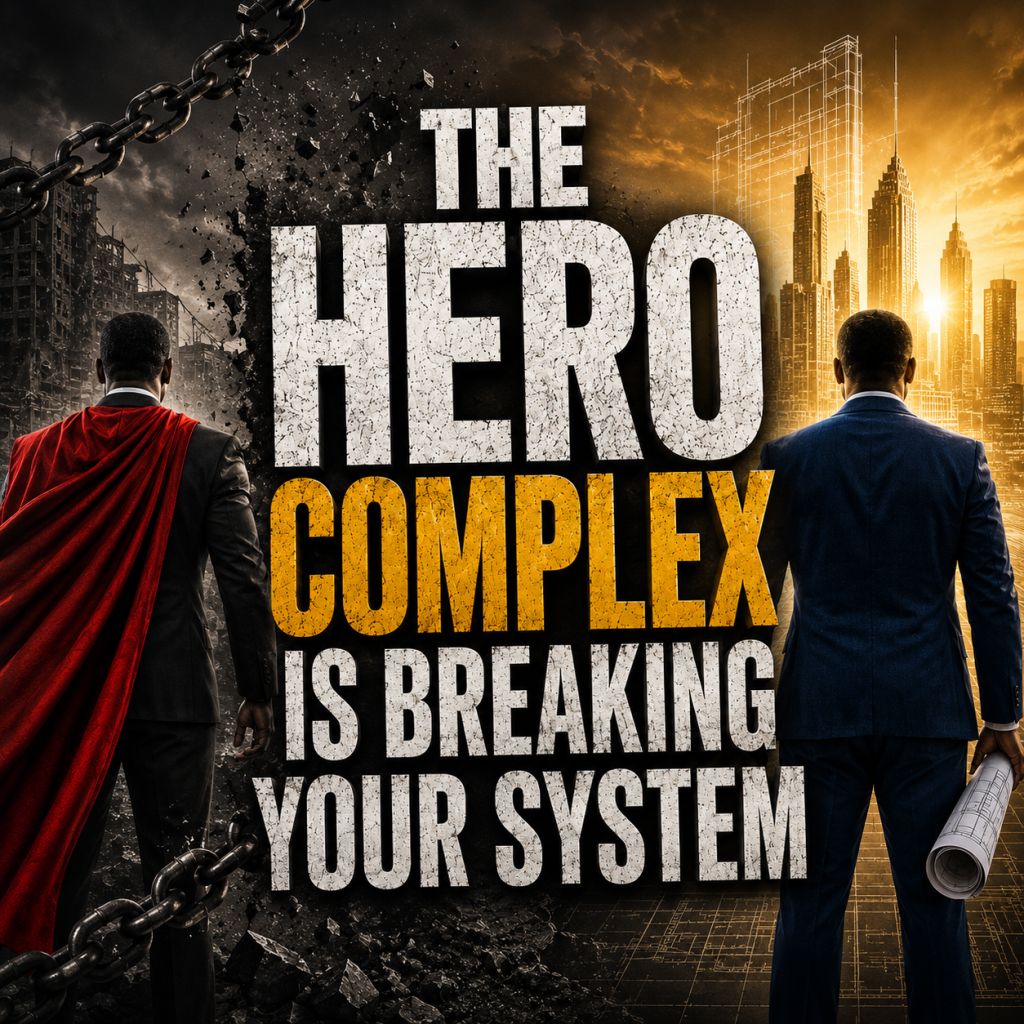
Theme: The Hero Complex Is Breaking Your System
Exodus 18:17-18 (KJV) - (17) And Moses' father in law said unto him, The thing that thou doest is not good. (18) Thou wilt surely wear away, both thou, and this people that is with thee: for this thing is too heavy for thee; thou art not able to perform it thyself alone.
The Hero Complex Is Breaking Your System
Many leaders believe being needed everywhere proves their value.
But often it reveals something far more dangerous:
operational weakness.
If:
- every decision depends on you
- every workflow requires you
- every emergency needs your involvement
- every process stops without you
…then you have not built sustainable structure.
You built dependency.
Many leaders unknowingly become:
- the emotional center
- the operational center
- the bottleneck
- the single point of failure
That creates:
- burnout
- organizational fragility
- leadership exhaustion
- unsustainable growth
True triumph is the transition from being the Hero to becoming the Architect.
The Psychology of Being Needed
The hero complex often feels noble.
Many leaders say:
- “I care deeply.”
- “I just want excellence.”
- “Nobody else can handle it correctly.”
But many times the deeper issue is emotional attachment to usefulness.
Some leaders unconsciously tie their identity to being indispensable.
Being needed creates emotional reward.
Fixing problems creates emotional reward.
Constant involvement creates emotional reward.
Over time, overfunctioning becomes normalized.
And eventually the organization becomes emotionally dependent on one personality instead of operationally stable through structure.
Being needed everywhere is not always leadership maturity. Sometimes it is system failure.
You Built a Cage of Dependency
Many leaders believe they built an organization.
But what they actually built was dependency.
Everything:
- flows through them
- waits on them
- depends on them
- stops without them
That creates operational fragility.
Organizations become trapped under the ceiling of one person’s bandwidth.
Growth slows because:
- every approval waits
- every process bottlenecks
- every workflow pauses
- every emergency escalates upward
Sustainable organizations cannot depend on constant emotional heroics.
Healthy systems decentralize execution while protecting accountability.
If your absence creates chaos, your organization has operational debt.
Moses Was Carrying Institutional Weight Personally
“And Moses’ father in law said unto him, The thing that thou doest is not good.
Thou wilt surely wear away, both thou, and this people that is with thee: for this thing is too heavy for thee; thou art not able to perform it thyself alone.”
— Exodus 18:17-18 (KJV)
Moses had:
- vision
- leadership
- calling
- responsibility
But Moses had also become the bottleneck.
Every issue depended on him personally.
Jethro recognized the danger immediately.
The problem was not passion.
The problem was structure.
Jethro did not give Moses motivation.
He gave him governance architecture.
He implemented:
- delegation
- leadership layers
- judicial structure
- distributed responsibility
That protected:
- Moses’ capacity
- the people’s needs
- organizational sustainability
You were never designed to personally carry institutional weight forever.
Delegation Without Governance Still Creates Dependency
Many leaders believe delegation alone solves dependency.
It does not.
Delegation without governance still creates confusion.
Real leadership maturity is not simply assigning tasks.
It is building:
- frameworks
- decision structure
- accountability systems
- operational clarity
- repeatable processes
Mature organizations reduce unnecessary dependence on emotional heroics by placing pressure into the protocol instead of the personality.
Healthy systems allow organizations to function consistently without requiring constant rescue from leadership.
Delegation removes tasks. Governance removes dependency.
Acts 6 Protected the Vision Through Structure
“Then the twelve called the multitude of the disciples unto them, and said, It is not reason that we should leave the word of God, and serve tables.”
— Acts 6:2 (KJV)
The Apostles faced operational overload.
They could have:
- overworked themselves
- micromanaged every issue
- personally handled every complaint
But instead they created structure.
They built a system that protected:
- focus
- vision
- sustainability
- organizational health
That is operational maturity.
Healthy leadership understands:
Structure protects the assignment from operational distraction.
Final Thought
Many leaders are exhausted because they became:
- the workflow
- the emergency response
- the approval system
- the operational center of everything
But sustainable leadership requires:
- structure
- governance
- systems
- distributed responsibility
- operational maturity
If your absence creates chaos, the system is too dependent on you.
Stop trying to be the hero.
Build the structure.
Create the workflows.
Develop the systems.
Because healthy leadership is not about constantly saving the day.
True triumph is building systems that survive without heroic intervention daily.


