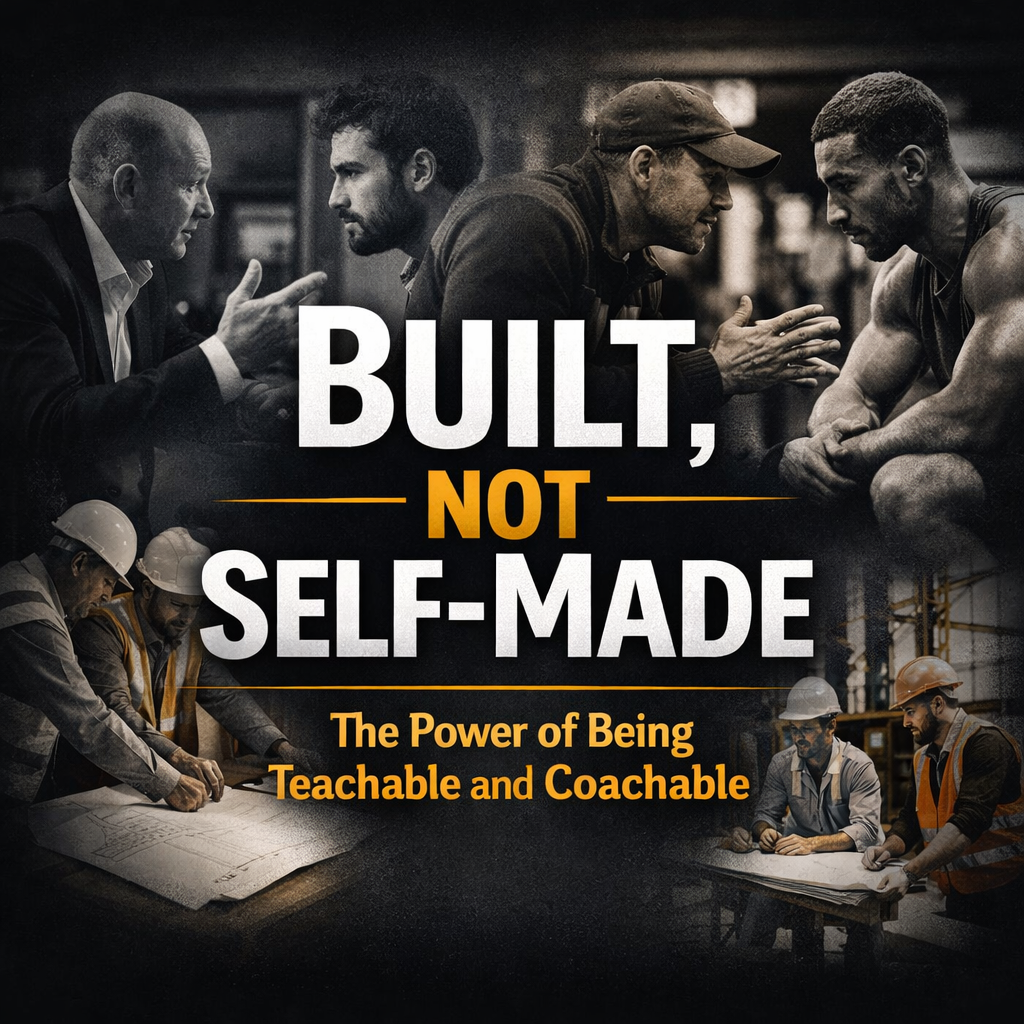
Theme: Built, Not Self-Made: The Power of Being Teachable and Coachable!
Proverbs 12:1 (KJV) “Whoso loveth instruction loveth knowledge: but he that hateth reproof is brutish.”
Built, Not Self-Made: The Power of Being Teachable and Coachable
There is a version of success that many people admire because it sounds powerful, independent, and untouchable. It is the image of the self-made person. The one who needed nobody, learned everything alone, fought every battle in silence, and built their life without correction, guidance, or help.
It sounds strong, but it is incomplete. In many cases, it is not even true.
Real success is rarely built in isolation. It is shaped through learning, sharpened through correction, strengthened through humility, and sustained through the willingness to keep growing. The strongest people are not the ones who never needed instruction. They are the ones who were wise enough to receive it, mature enough to apply it, and disciplined enough to let it change them.
You are not self-made. You are built.
And how well you are built will always be connected to how teachable and coachable you are willing to become.
Instruction Is Not Weakness, It Is Wisdom
Proverbs 12:1 (KJV) says, “Whoso loveth instruction loveth knowledge: but he that hateth reproof is brutish.” That verse does not soften the message, and it should not. Growth has always been tied to instruction. Maturity has always been tied to correction. Wisdom has always required the humility to hear what you may not want to hear.
A lot of people say they want increase, but they resist the very process that prepares them to carry it. They want to grow without being corrected. They want to lead without being challenged. They want results without accountability. But instruction is not an interruption to growth. It is part of growth.
You cannot consistently ask for elevation while rejecting the voices, lessons, and truth that help prepare you for it.
People who love instruction do not love being embarrassed. They love becoming better. They understand that the temporary discomfort of correction is far cheaper than the long-term cost of remaining unchanged.
The Self-Made Mindset Often Hides an Untouched Ego
The language of being self-made can sometimes sound empowering, but underneath it often sits something deeper: pride, fear, and an unhealthy attachment to self-protection. Some people do not resist coaching because they are strong. They resist it because they do not want their blind spots exposed. They do not want to admit they still have room to grow. They do not want anyone touching the image they have built of themselves.
That is where the danger begins.
When a person becomes more committed to appearing capable than actually becoming stronger, growth slows down. They start defending what should be refined. They start protecting what should be challenged. They start treating correction like disrespect, when in reality it may be the very thing that could help preserve their future.
A closed heart can make a gifted person stagnant.
You can have talent and still plateau. You can have vision and still stay stuck. You can have potential and still underperform if your pride keeps rejecting what could sharpen you.
Success Belongs to People Who Learn Faster Than They Defend
Hard work matters, but effort alone is not the highest advantage. Plenty of people work hard. Plenty of people stay busy. Plenty of people are committed. But if all that effort is paired with the same patterns, the same thinking, and the same refusal to adjust, hard work can become an exhausting loop instead of a path forward.
What separates people over time is not just how much they work. It is how quickly they learn, how honestly they evaluate themselves, and how fast they apply what needs to change.
Effort without adjustment leads to exhaustion, not elevation.
The people who move ahead are often the people who do not spend weeks arguing with the truth. They hear it, process it, and use it. They do not make perfection their excuse for delay. They understand that progress is often built on timely correction.
Success has a lot to do with speed of learning. If you learn slowly because your ego is always in the way, your growth will be slower than it needs to be.
Coachability Breaks Ceilings That Talent Cannot
Talent can get attention. Talent can open doors. Talent can create opportunities. But talent, by itself, cannot guarantee growth. It cannot guarantee maturity. It cannot guarantee sustainability. In some cases, talent can even become dangerous when it is not paired with humility, because a gifted person can begin believing they no longer need to be sharpened.
That is often when the ceiling appears.
Anything that cannot be corrected cannot keep growing.
A coachable person can take a weakness, expose it, work on it, and come back stronger. An uncoachable person will often spend more energy defending the weakness than developing the strength. Over time, one keeps growing while the other quietly stalls out.
This is why coachability is such a powerful advantage. It gives a person the ability to turn mistakes into strategy, truth into momentum, and correction into progress. Talent may start the journey, but coachability is often what keeps the journey alive.
Growth Requires You to Outgrow the Version of You That Got You Here
One of the hardest realities of personal growth is this: the version of you that helped you survive one season may not be strong enough to carry the next one. The thinking that got you here may not be deep enough for where you are going. The habits that once worked may eventually become limitations. The confidence that once protected you may harden into pride if you are not careful.
That is why real growth always involves some form of release.
What got you here will not always take you there.
Teachable people understand that they are not betraying themselves by evolving. They are preparing themselves. They are willing to let outdated mindsets die. They are willing to release methods that no longer work. They are willing to admit when something needs to change because they care more about progress than preserving comfort.
The people who keep growing are rarely the people who think they have arrived. They are the ones who stay flexible enough to become who their next level requires.
Teachable People Know How to Separate Correction from Identity
One of the clearest marks of maturity is the ability to receive correction without letting it destroy your sense of self. A teachable person does not hear feedback and immediately translate it into personal failure. They understand the difference between “this needs improvement” and “I am not enough.”
That difference matters more than many people realize.
When someone ties every correction to their identity, they become defensive. They shut down, explain, deflect, or emotionally retreat. But when someone knows who they are and stays grounded in growth, they can hear truth without losing their footing.
Correction is not always a statement about your value. Many times, it is a roadmap for your improvement.
That mindset changes everything. It allows you to stay open. It allows you to stay present. It allows you to take what is useful, apply it wisely, and keep moving without turning every hard conversation into an internal crisis.
Your Environment Will Either Stretch You or Settle You
No matter how gifted, motivated, or disciplined a person may be, environment still matters. The people around you shape what gets normalized in your thinking, your habits, and your standards. If you are in spaces where truth is avoided, accountability is rare, and comfort is protected at all costs, your growth will eventually feel the effect of that environment.
The wrong room can make stagnation feel normal. The wrong room can make average feel acceptable. The wrong room can slowly teach you to stop reaching.
Some people do not need more motivation. They need a different room.
You need environments where growth is normal, where truth can be spoken without everything turning personal, and where the people around you care more about your development than your temporary comfort. A healthy room will not only celebrate your strengths. It will also expose your gaps and help you close them.
If You Are Always the Teacher, You May Be Starving as a Student
There comes a point in many people’s lives where they become so used to leading, pouring, explaining, and carrying that they quietly lose their posture as a learner. They get comfortable being the one with the answers. They are always the one helping, guiding, and teaching, but they stop putting themselves in spaces where they are challenged, stretched, and sharpened.
That can feel productive, but it is dangerous.
If you are always the teacher and never the student, your growth may be slowing down more than you realize.
Strong people still need strong rooms. Leaders still need correction. Builders still need voices that can sharpen their thinking. There is nothing weak about remaining a student. In fact, many of the strongest leaders are the ones who never lose their ability to sit, listen, learn, and adjust.
Growth accelerates when you stay close to people who can see beyond where you currently are.
Pressure Reveals Whether You Have Built Habits or Just Good Intentions
Pressure has a way of exposing the truth. It reveals whether your discipline is real, whether your preparation is deep, and whether your mindset can hold when things get tight. In stressful moments, people do not usually rise to their hopes. They fall back on their training.
That is why coachability matters before the critical moment arrives.
Pressure does not create who you are. It reveals what you have practiced becoming.
If you have practiced humility, you will remain reachable under pressure. If you have practiced accountability, you will stay honest under pressure. If you have practiced discipline, you will still execute under pressure. But if you have practiced defensiveness, excuses, and delay, pressure will expose that too.
This is why teachable and coachable people are often stronger in difficult moments. They have trained themselves to adjust instead of collapse.
The Gap Between Average and Elite Is Often the Speed of Adjustment
One of the clearest differences between average performers and elite performers is how quickly they respond to truth. Average people may hear feedback, feel it, sit with it, debate it, overthink it, and delay what needs to change. Elite people hear what matters, make the adjustment, and move.
That does not mean the truth never stings. It means they do not let the sting become an excuse.
Speed of correction often determines speed of growth.
The longer a person takes to adjust, the longer they postpone their own progress. The more quickly a person can receive truth and act on it, the faster they build momentum. Sometimes the issue is not lack of ability. Sometimes the issue is simply that pride is slowing down the process.
Growth is not only about what you hear. It is also about how quickly you move on what you hear.
People Who Can Be Developed Become Valuable in Every Room
High-level people, strong leaders, and wise builders are not only looking for gifted people. They are looking for people they can trust with truth. They are looking for people who can be poured into without wasting the investment. They are looking for people who can hear, apply, mature, and improve.
That kind of person becomes valuable everywhere.
Teachable people become valuable because they are developable.
When people see that you can receive feedback and turn it into stronger execution, they trust you with more. They give you more responsibility. They open larger doors. They stay engaged in your growth because they know their guidance is not being ignored.
Access is often tied to developability. Many opportunities do not go to the loudest person, the most polished person, or even the most talented person. They go to the one who can be trusted to grow with what they are given.
The Higher You Go, the More Intentional You Must Be About Staying Open
Leadership carries a hidden danger. The higher a person rises, the easier it becomes for correction to disappear. People begin protecting the title, protecting the position, protecting the image, and before long the leader is no longer being sharpened the way they once were.
That is dangerous, because blind spots grow best in silence.
If nobody can challenge you, you are more vulnerable than you look.
Strong leaders do not avoid correction. They welcome it. They build cultures where truth is not punished, where feedback is not viewed as disrespect, and where growth stays part of the standard. A leader’s openness to correction does more than protect them personally. It shapes the health of everyone connected to them.
The stronger you become, the more intentional you must be about staying reachable, teachable, and coachable.
The Real Win Is Not Being Right, It Is Being Refined
At the end of the day, victory is not about winning every argument, proving everyone wrong, or protecting an image of perfection. Real victory is deeper than that. It is about becoming the kind of person who can carry what they say they want. It is about becoming more disciplined, more honest, more mature, more prepared, and more aligned.
A lot of people want the next level, but they do not want the refinement that comes with it. They want elevation without correction. They want growth without discomfort. They want more responsibility without deeper accountability.
The real question is not whether you are talented enough. The real question is whether you can be developed.
If the answer is yes, then your story is still expanding. Your growth is still alive. Your ceiling is still breakable. Your future still has room to stretch.
You are not self-made. You are built. And the more teachable and coachable you become, the stronger that foundation will be.
Listen to the Full Episode
You can hear the full Triumph Tuesday message, “Built, Not Self-Made: The Power of Being Teachable and Coachable” on Afternoon Praise on Wayvve Radio.
Listen live or explore more uplifting content at:


