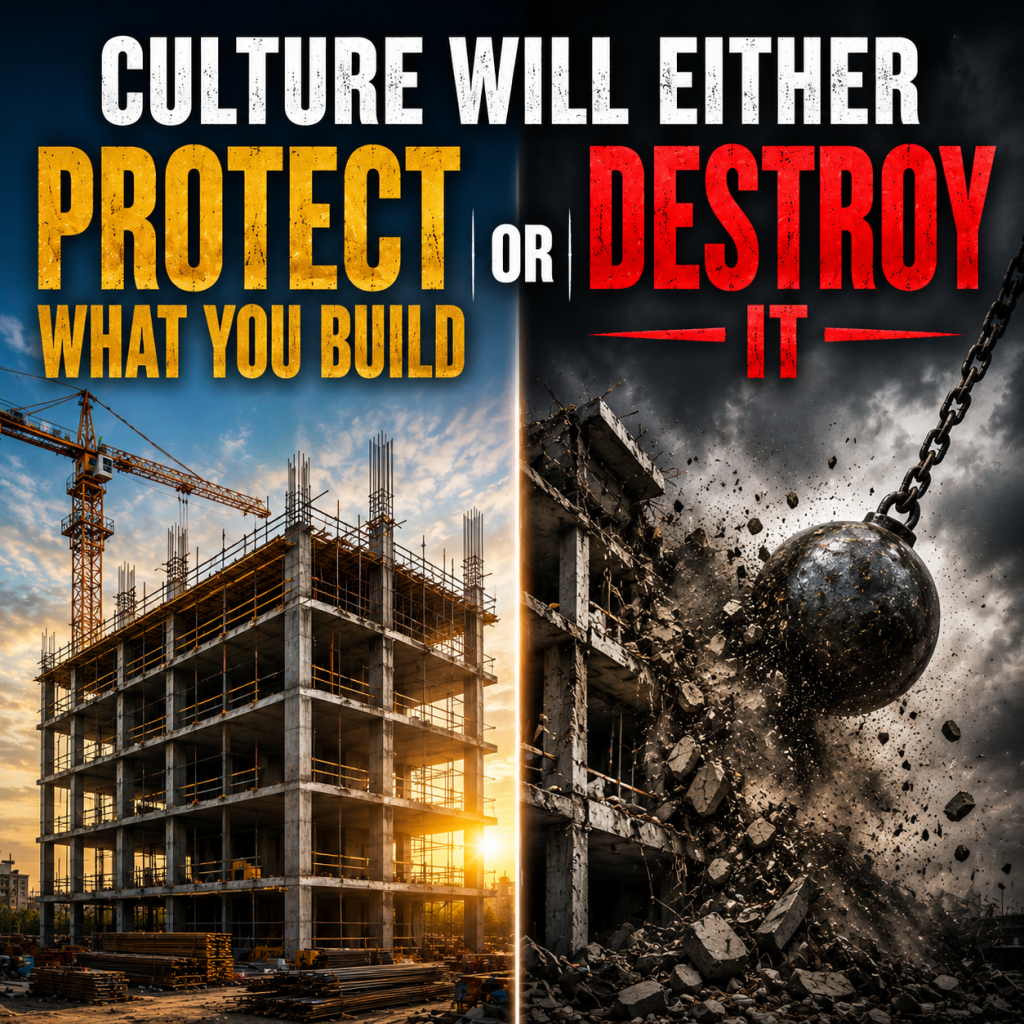
Theme: Culture Will Either Protect What You Build or Destroy It
Nehemiah 4:6 (KJV) - So built we the wall; and all the wall was joined together unto the half thereof: for the people had a mind to work.
Culture Will Either Protect What You Build or Destroy It
Many organizations focus heavily on strategy while ignoring culture.
But strategy is only the map.
Culture is the terrain.
You can build a billion-dollar vision on paper and still destroy it with unhealthy culture.
Because culture determines:
- how people communicate
- how pressure is handled
- how trust is protected
- how accountability functions
- how leadership behaves under stress
Culture is not decorative.
Culture is operational.
And eventually culture determines whether what you build survives pressure or collapses underneath it.
Pressure Reveals the Real Environment
Pressure does not create culture.
Pressure exposes it.
Easy seasons hide dysfunction.
But pressure reveals:
- leadership maturity
- communication habits
- organizational trust
- emotional stability
- system health
Anybody can appear aligned during comfortable seasons.
But adversity removes performance masks.
Eventually people stop performing values and start revealing habits.
Under pressure, organizations fall to culture.
The storm does not create instability.
The storm reveals what was unstable all along.
Pressure exposes:
- emotional maturity
- leadership discipline
- communication consistency
- relational health
- organizational honesty
Pressure forces organizations to operate from their true culture instead of their public image.
What Leadership Tolerates Becomes Culture
Culture is built through repetition.
Not speeches.
Not branding.
Not mission statements.
Repeated tolerated behavior eventually becomes normalized behavior.
This is how unhealthy environments become dangerous slowly.
Compromise becomes common.
Confusion becomes accepted.
Dysfunction becomes normalized.
NASA called this: The Normalization of Deviance.
Small compromises repeated long enough eventually stop feeling dangerous.
Leadership behavior silently teaches:
- communication standards
- accountability expectations
- conflict response
- emotional behavior
People eventually study what leadership ignores more than what leadership says.
Leadership silence often becomes emotional permission for dysfunction to continue growing.
And once dysfunction becomes normalized, correction starts feeling offensive instead of necessary.
Nehemiah Built More Than a Wall
Nehemiah did not just build structure.
He built culture.
“So built we the wall; and all the wall was joined together unto the half thereof: for the people had a mind to work.”
— Nehemiah 4:6 (KJV)
The wall was physical.
But the culture was psychological.
Nehemiah created:
- ownership
- unity
- alignment
- emotional investment
- collective responsibility
Families built near their own homes.
That created personal investment in the mission.
Healthy culture transforms workers into owners mentally and emotionally.
The people were no longer simply building a wall.
They were protecting their future.
And environments with emotional ownership survive pressure better than disconnected environments.
Psychological Safety Affects Performance
Google’s Project Aristotle discovered that the highest-performing teams were not simply the smartest teams.
They were the safest teams psychologically.
Fear-based environments damage:
- communication
- creativity
- honesty
- innovation
- trust
When people fear embarrassment, punishment, or emotional instability, they stop communicating honestly.
Fear creates silence before it creates collapse.
Healthy culture creates safety for:
- growth
- correction
- accountability
- truth
Organizations become dangerous when people no longer feel safe reporting problems honestly.
And once honesty disappears, environments begin operating blind.
Emotionally safe environments increase:
- collaboration
- problem-solving
- strategic thinking
- innovation
Healthy culture allows truth to flow upward before problems become destructive.
Culture Protects Vision After Excitement Fades
Excitement can create momentum.
But culture sustains momentum.
Because eventually:
- motivation fades
- energy fluctuates
- pressure increases
- stress rises
And when those moments arrive, culture takes over.
Culture is what remains when motivation disappears.
Healthy culture protects:
- consistency
- discipline
- standards
- communication
- trust
Organizations with strong culture survive difficult seasons better because the systems and behaviors are already rooted deeply.
Excitement may inspire people temporarily.
But healthy culture creates sustainable behavior long after emotions fluctuate.
Sustainable organizations are built on principles, not emotional momentum alone.
Sustainable Growth Requires Cultural Alignment
You can scale products with money.
But you scale legacy through culture.
Sustainable growth requires:
- trust
- alignment
- communication
- accountability
- emotional stability
- healthy leadership
Growth without cultural health eventually creates organizational strain.
Weak culture slowly destroys:
- clarity
- trust
- motivation
- creativity
- leadership stability
Healthy systems scale better when healthy culture already exists underneath them.
Because culture becomes the glue holding organizations together under pressure.
Sustainable growth requires emotional and operational alignment beneath the surface.
Healthy culture stabilizes environments during uncertainty while weak culture creates emotional fragmentation.
Final Thought
Culture is never neutral.
It is always shaping behavior, protecting standards, and influencing environments emotionally.
This entire week reminded us:
- what you allow becomes culture
- red flags do not fix themselves
- healthy things cannot grow in toxic environments
- you cannot scale dysfunction
And today we close with the final truth:
Culture will either protect what you build or destroy it.
Because eventually pressure exposes everything underneath the surface.
And when pressure rises, people do not rise to intentions.
They fall to culture.
Before asking for more growth, make sure your culture is healthy enough to survive the pressure growth creates.
Because eventually: what leadership repeatedly allows becomes the environment everybody else is forced to live in.
Healthy culture is not built accidentally.
It is protected intentionally.


