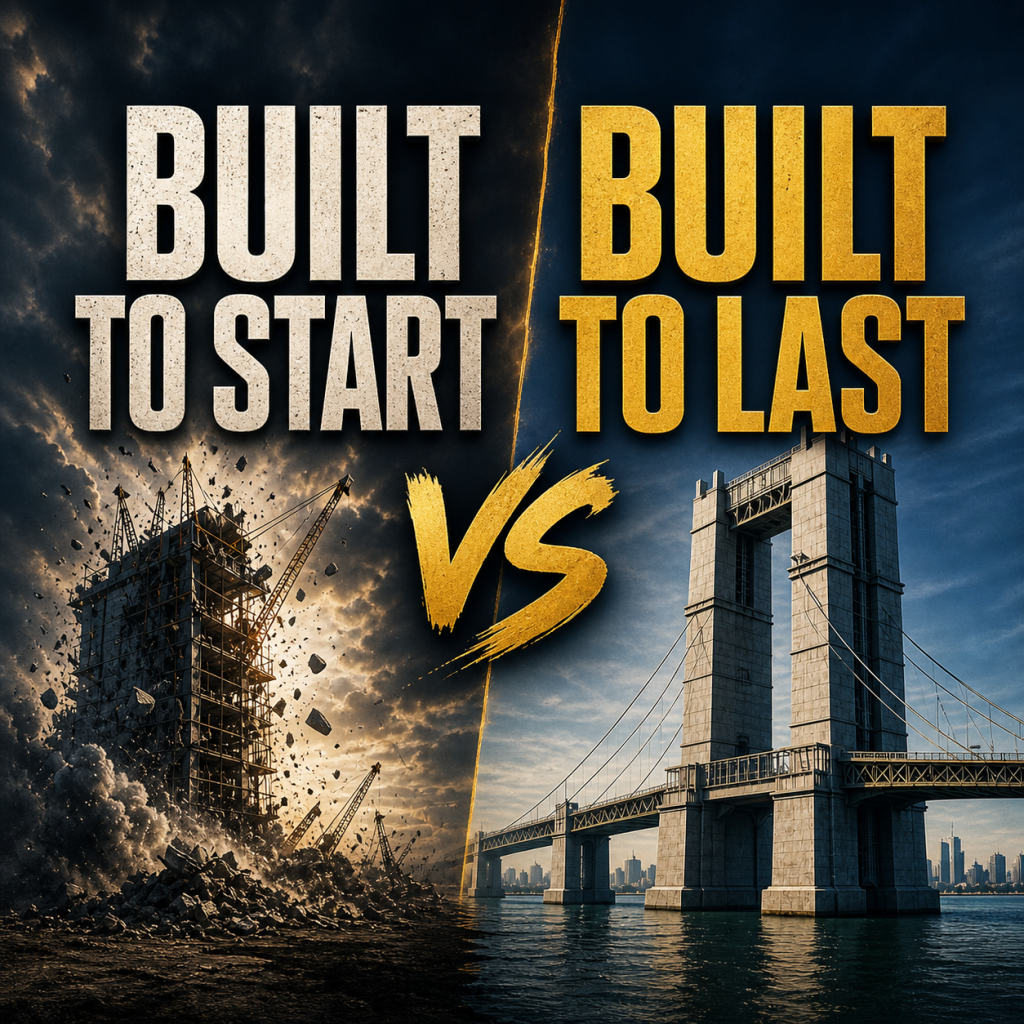
Theme: Built to Start vs Built to Last
Luke 14:28 (KJV) For which of you, intending to build a tower, sitteth not down first, and counteth the cost, whether he have sufficient to finish it?
Built to Start vs Built to Last
What You Build Must Be Built to Last
This week has been about one thing: engineering the environment where your gift can function at a high level.
It started with defining the gift, building the strategy, governing the environment, and systemizing execution.
But none of that matters if what you build cannot last.
There is a difference between starting something and sustaining something.
Most people are built to start. Very few are built to last.
Starting Is Biological. Lasting Is Structural.
Starting feels natural because it is biological.
When something is new, your brain releases dopamine, creating excitement, energy, and motivation. This is what fuels the beginning of most ideas, goals, and projects.
But dopamine is not designed to sustain effort. It is designed to initiate action.
Once the novelty fades, so does the emotional drive.
If your process depends on excitement, it will collapse when excitement disappears.
That is why lasting requires structure, not emotion.
The Messy Middle Is Where Most People Quit
Every meaningful endeavor has a phase where the excitement is gone, but the results are not yet visible.
This is the “messy middle.”
It is the stage where motivation drops and discipline must take over.
Most people do not fail at the start. They fail in the stretch.
They planned for the beginning but never prepared for the process required to finish.
Desire Is Not Capacity
One of the most dangerous assumptions is believing that because you want something, you are ready for it.
Desire creates vision, but capacity determines sustainability.
Research shows that people consistently overestimate their ability to execute long-term, often by a significant margin.
Planning based on who you hope to be instead of who you are creates a gap that reality will eventually expose.
The Gap Between Intention and Execution
Intentions are easy to declare, but difficult to sustain.
There is a consistent gap between what people intend to do and what they actually maintain over time.
This gap is not caused by a lack of motivation. It is caused by a lack of structure.
Pressure will always expose what has not been properly built.
Effort Cannot Sustain What Systems Must Carry
Effort can produce short-term results, but it cannot sustain long-term success.
Energy fluctuates. Focus shifts. Life introduces variables that effort alone cannot absorb.
Systems are what allow performance to continue when effort is no longer enough.
They create repeatability, reduce decision fatigue, and maintain consistency over time.
False Starts Create Real Damage
Starting without finishing does more than delay progress. It weakens trust.
Repeated false starts create skepticism, both internally and externally. People begin to disengage, expecting the same pattern to repeat.
Inconsistency does not just slow growth. It damages credibility.
Most People Are Addicted to Starting
Starting feels productive. It creates the illusion of progress.
But many people are not pursuing completion. They are pursuing the feeling of beginning.
Starting provides emotional satisfaction. Sustaining requires disciplined decision-making.
This is why many initiatives begin but never mature.
Identity Determines What Lasts
Sustainability is not rooted in effort. It is rooted in identity.
A person who focuses on outcomes will struggle with consistency. A person who focuses on identity will naturally produce it.
What you consistently do is a reflection of who you believe you are.
When identity aligns with action, sustainability follows.
Leadership Requires Structure, Not Just Vision
Vision can initiate movement, but structure sustains it.
Without systems, leadership becomes reactive. Decisions become constant, and execution becomes inconsistent.
Leadership is not proven by what you start. It is proven by what you can maintain.
Relationships Must Be Built to Last Too
This principle extends beyond business into personal life.
Relationships are not sustained by emotion alone. They are sustained by consistent communication, clear expectations, and reliable behavior.
Without structure, relationships become unstable because they rely on changing emotions instead of consistent patterns.
Complexity Will Test What You Built
Growth introduces complexity.
More responsibility, more decisions, more pressure.
If what you built is not designed to handle that complexity, it will break under it.
Growth does not create problems. It reveals them.
Capacity + Commitment = Sustainability
Sustainability is not accidental. It is the result of two factors working together.
Capacity is your ability to carry the weight. Commitment is your willingness to remain consistent under pressure.
Without both, what you build will not last.
Final Thought
Luke 14:28 (KJV)
“For which of you, intending to build a tower, sitteth not down first, and counteth the cost…”
Counting the cost is not about hesitation. It is about preparation.
Starting requires desire. Lasting requires capacity, structure, and commitment.


