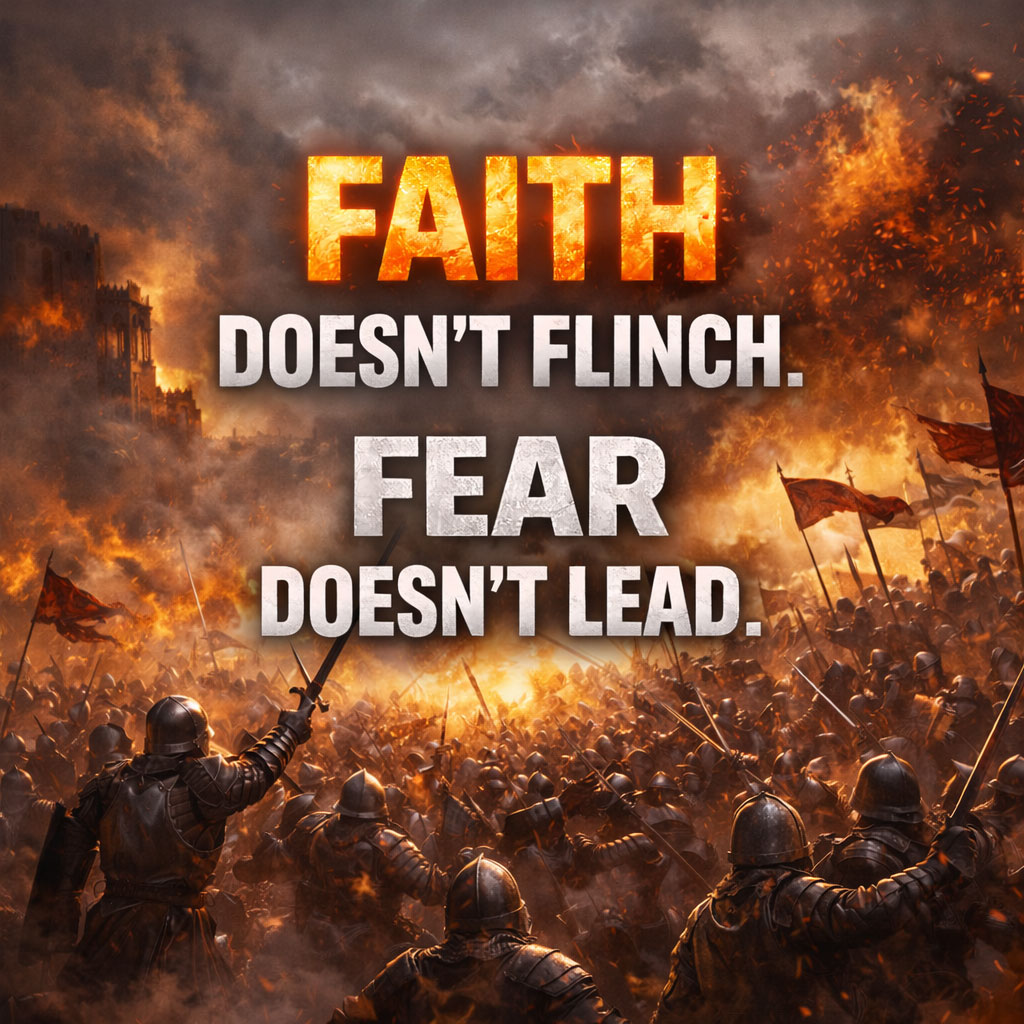
Theme: Faith Doesn’t Flinch. Fear Doesn’t Lead.
2 Timothy 1:7 (KJV) “For God hath not given us the spirit of fear; but of power, and of love, and of a sound mind.”
Faith Doesn’t Flinch. Fear Doesn’t Lead.
Faith is often misunderstood as something quiet, internal, and still. But real faith moves. It doesn’t sit back and wait for perfect conditions, and it doesn’t wait until everything feels right. Faith responds to instruction, not emotion.
When you truly believe something is yours, your actions begin to reflect it. You prepare differently. You move differently. You make decisions with confidence instead of hesitation. Movement becomes the evidence of belief.
Many people say they have faith, but their actions reveal uncertainty. Because faith without movement is just agreement. And agreement without execution produces no results.
Fear and Faith Cannot Lead at the Same Time
Fear and faith are not just feelings—they are systems. They influence how you process opportunities, how you respond under pressure, and how you make decisions in critical moments.
Fear slows you down. It causes hesitation, overthinking, and delay. Faith, on the other hand, creates forward movement. It aligns your actions with what you believe, even when the outcome is not fully visible.
Every day, you are choosing which system leads you. And the difference between staying stuck and moving forward often comes down to that one decision.
The Hidden Nature of Fear
Fear rarely presents itself in obvious ways. It doesn’t always look like panic or anxiety. More often, it shows up as logic, caution, or even what feels like wisdom.
It sounds like “I just need more time” or “I want to make sure everything is perfect.” But beneath those thoughts is hesitation. And hesitation, over time, becomes a pattern.
When hesitation becomes a habit, it prevents movement. And when movement stops, growth stops. What feels like careful thinking can actually be avoidance in disguise.
The Science Behind Fear and Hesitation
Fear is not just emotional—it is biological. It activates the brain’s survival system, increasing perceived risk and decreasing your willingness to act boldly.
In this state, your focus shifts from opportunity to protection. You begin to analyze every possible negative outcome, which slows down decision-making and interrupts execution.
This is why hesitation feels so strong. Your mind is trying to protect you, even when there is no real danger. But you cannot build something meaningful while operating from a constant need to protect your comfort.
Preparation Changes Everything
Preparation is one of the most powerful tools for overcoming fear. When you prepare, your brain shifts from emotional response to logical execution.
Studies show that mental rehearsal activates the same neural pathways as physical performance. This means that when you practice, visualize, and study, you are already building the ability to execute.
Preparation reduces uncertainty. It builds familiarity. And familiarity reduces fear. When you’ve done the work consistently, you don’t have to panic in the moment—you perform.
Confidence Is Built Through Repetition
Confidence is often mistaken as something you either have or don’t have. In reality, it is built through repetition and discipline.
The more you repeat an action, the more your brain automates the process. This reduces cognitive load, allowing you to execute without overthinking.
Confidence is not hype or motivation. It is familiarity. It is the result of showing up consistently, practicing intentionally, and building a level of comfort through repetition.
Hesitation Has a Cost
Hesitation is not neutral. It carries a cost.
Overthinking disrupts performance and can significantly reduce your chances of success. When you pause too long, you lose momentum. When you lose momentum, execution becomes more difficult.
Opportunities do not wait for perfect timing. They respond to decisive action. And often, the difference between success and missed opportunity is the ability to move when it matters most.
Faith Requires Discipline
Faith alone is not enough. It must be supported by discipline.
Faith gives you the vision. Discipline prepares you for the responsibility that comes with it. Without discipline, belief can lead to frustration because you are expecting results without building the capacity to sustain them.
When faith and discipline work together, execution becomes natural. You are no longer hoping for results—you are prepared for them.
Understanding Who You Are
The foundation of fearless execution is understanding your identity.
Scripture reminds us that fear is not part of our design. We are given power, clarity, and a sound mind. This means fear is not something we are meant to operate in.
When fear shows up, it is not confirmation to stop. It is a signal to realign with what has already been given to you.
Pressure Is Part of the Process
Resistance is not a sign that you are off track. It is part of the process.
Challenges will come. Pressure will show up. But these moments do not determine the outcome. They reveal how prepared you are to handle the situation.
When you understand that pressure is part of growth, you stop interpreting difficulty as failure. Instead, you see it as a necessary step toward the result.
Consistency Produces Results
Success is not built in single moments. It is built through consistent action over time.
Emotions change. Motivation comes and goes. But consistency creates patterns, and patterns produce results.
When you continue to show up, even when it is difficult, you position yourself to receive the outcome that consistency produces.
Execute Without Hesitation
At some point, preparation must turn into execution.
There is no perfect moment. There is no perfect condition. There is only the decision to move.
When you study with intention, practice with discipline, and move with confidence, you eliminate the space where fear operates.
Faith does not hesitate. It moves forward with clarity and purpose. And when you align your actions with that level of belief, execution becomes unstoppable.
Faith doesn’t flinch. Fear doesn’t lead.


